Why One CGI Render Isn’t Enough Anymore: What Modern Off-Plan Buyers Actually Need to See
For years, the gold standard of off-plan property marketing followed a predictable formula: hire an architectural visualisation studio, produce a handful of hyper-polished hero renders, print an embossed brochure, and wait for high-net-worth investors to sign on the dotted line.
That formula used to work. Today, it is rapidly becoming an expensive bottleneck.
As developments grow more ambitious and buyers become more discerning, the property market is undergoing a fundamental shift. High value off plan purchasers is no longer satisfied with passive representations of space.
A single static render captures an apartment from one fixed angle, in one specific lighting scenario, with one predetermined set of finishes. In a high stakes transaction where decisions represent substantial financial commitments, passive imagery leaves critical spatial and atmospheric questions unanswered.
Here is why static visualisations are falling short and what forward-thinking developers are using instead to compress decision cycles and protect pre-sale margins.
The Reality Check: The Limitation of Static Perfection
When an off plan buyer views a standard architectural render, they understand on an instinctive level that the image has been engineered to showcase the property at its absolute best. The angle is curated, the lighting is calibrated, and every imperfection has been styled away.
While this generates initial interest, it fails to build long term transactional certainty. During private viewings or sales suite consultations, static imagery inevitably triggers buyer friction:
- "How does the open-plan layout actually feel when standing near the kitchen island?"
- "What will this living area look like when the sun goes down?"
- "Can we see how the space breathes if we opt for lighter timber rather than dark veneer?"
Whenever an agent has to answer with, "You’ll have to imagine that," momentum stalls. In off plan sales, imagination creates doubt, and doubt delays contracts.
1. Spatial Freedom: Letting Buyers Walk Before They Commit
The primary shortcoming of a static render is the complete absence of viewer autonomy. A fixed camera angle forces prospective buyers to look where the developer wants them to look, rather than where they want to explore.
By integrating 360° virtual tours and real-time interactive walkthroughs, developers restore agency to the buyer.
Prospects can navigate freely between living spaces, inspect sightlines from the kitchen to the terrace, check ceiling transitions, and evaluate proportional scale at their own pace. Moving from passive spectator to active explorer fundamentally shifts buyer psychology from speculative interest to emotional ownership.
2. Instant Personalisation: Removing Speculation from Specification
Customisation is central to luxury off-plan sales. Yet, traditional marketing collateral requires buyers to cross reference tiny physical material swatches with a 2D floor plan and a static render.
Real-time material configurators remove that guesswork entirely.
With interactive toggles, buyers can switch between joinery options, marble worktops, flooring textures, and brassware with a single tap. Seeing customisations rendered instantly within the actual digital twin of their apartment gives buyers immediate clarity, eliminating protracted back and forth deliberations and accelerating reservation signatures.
3. Atmospheric Value: Demonstrating Day to Night Livability
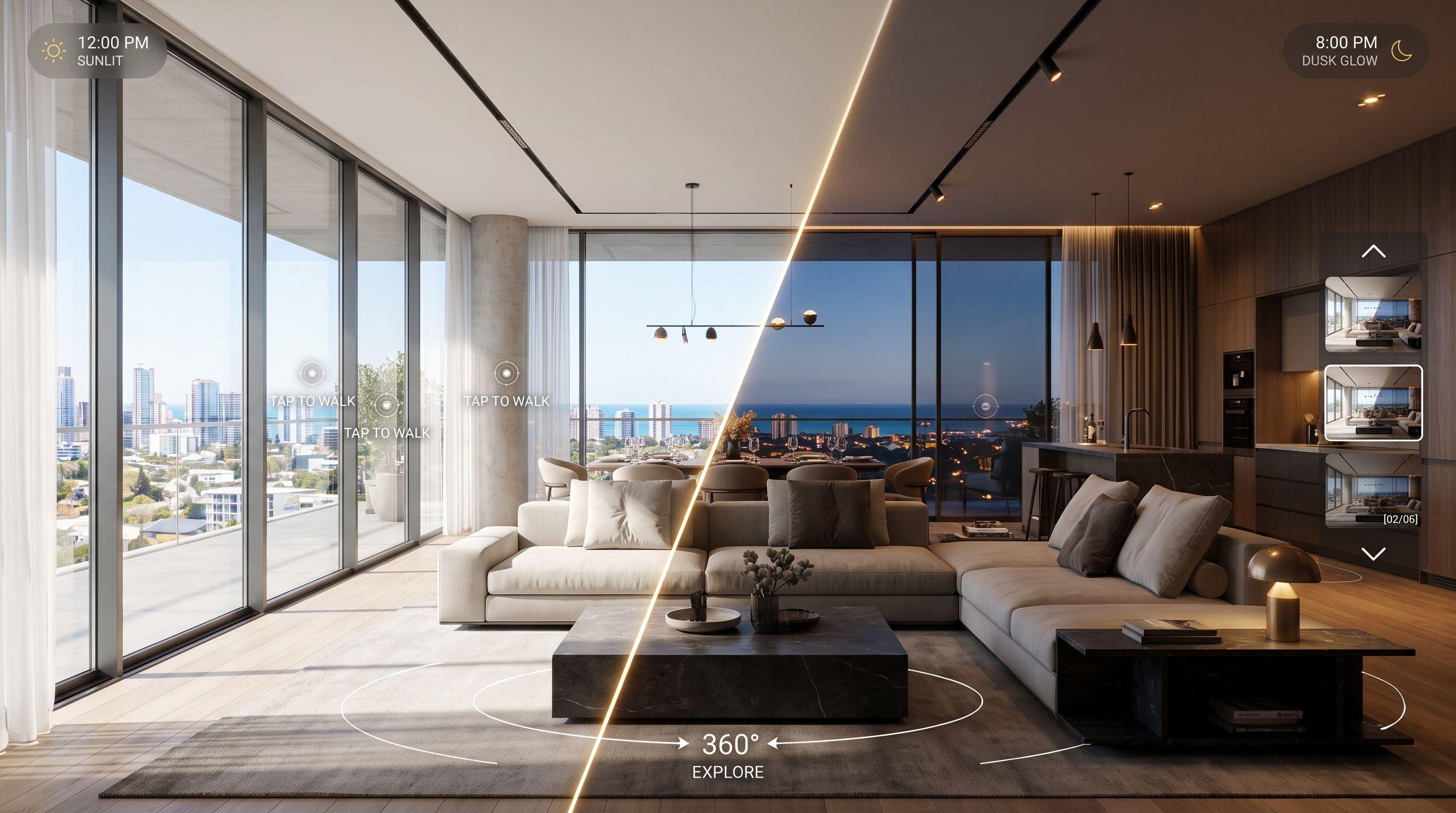
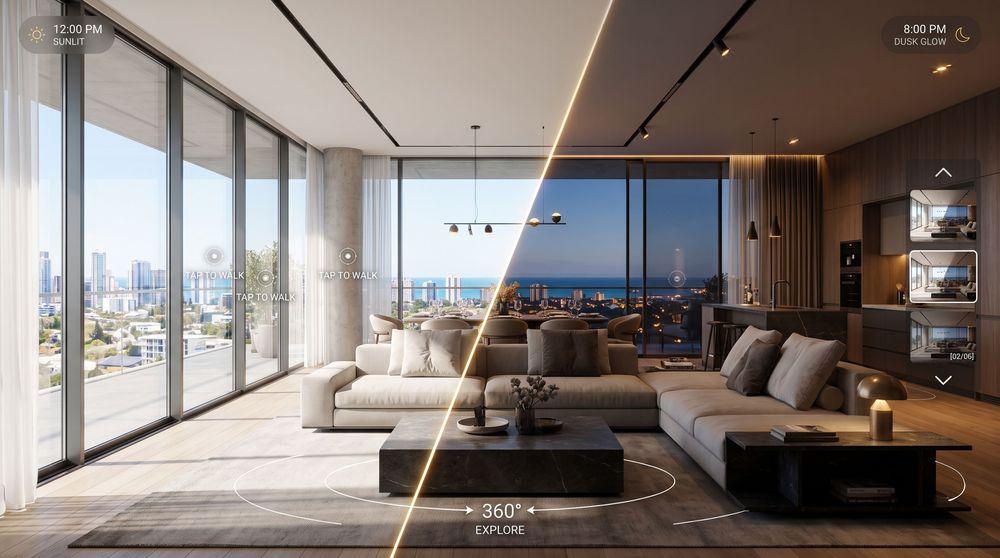
Natural light is among the strongest value drivers in residential real estate. A static midday render may prove that an apartment is bright at noon, but it fails to illustrate how the home will feel at 8:00 PM when entertaining guests or unwinding after work.
Through dynamic daylight simulations, interactive visualisation allows buyers to sweep the sun across the horizon from crisp morning light to warm ambient twilight.
This daylight to dusk continuum reassures buyers about spatial livability across all 24 hours of the day, transforming an abstract architectural promise into a palpable living experience.
The Commercial Verdict: Static Sells the Brochure. Interactive Sells the Unit.
High resolution static CGI will always have a place in top of funnel marketing on hoardings, billboards, and social media feeds. But when high intent prospects enter your sales suite, relying solely on static imagery leaves too much money on the table.
Interactive visualisation is no longer an experimental gimmick; it is an essential conversion engine. By eliminating uncertainty, addressing granular layout questions, and allowing real time personalization, interactive tools significantly reduce friction across the sales pipeline.
Developers who continue selling static promises risk falling behind. Those who deliver interactive certainty are the ones closing sales suites before the foundation is even poured.
Is your off-plan sales suite built for today’s buyer expectations?